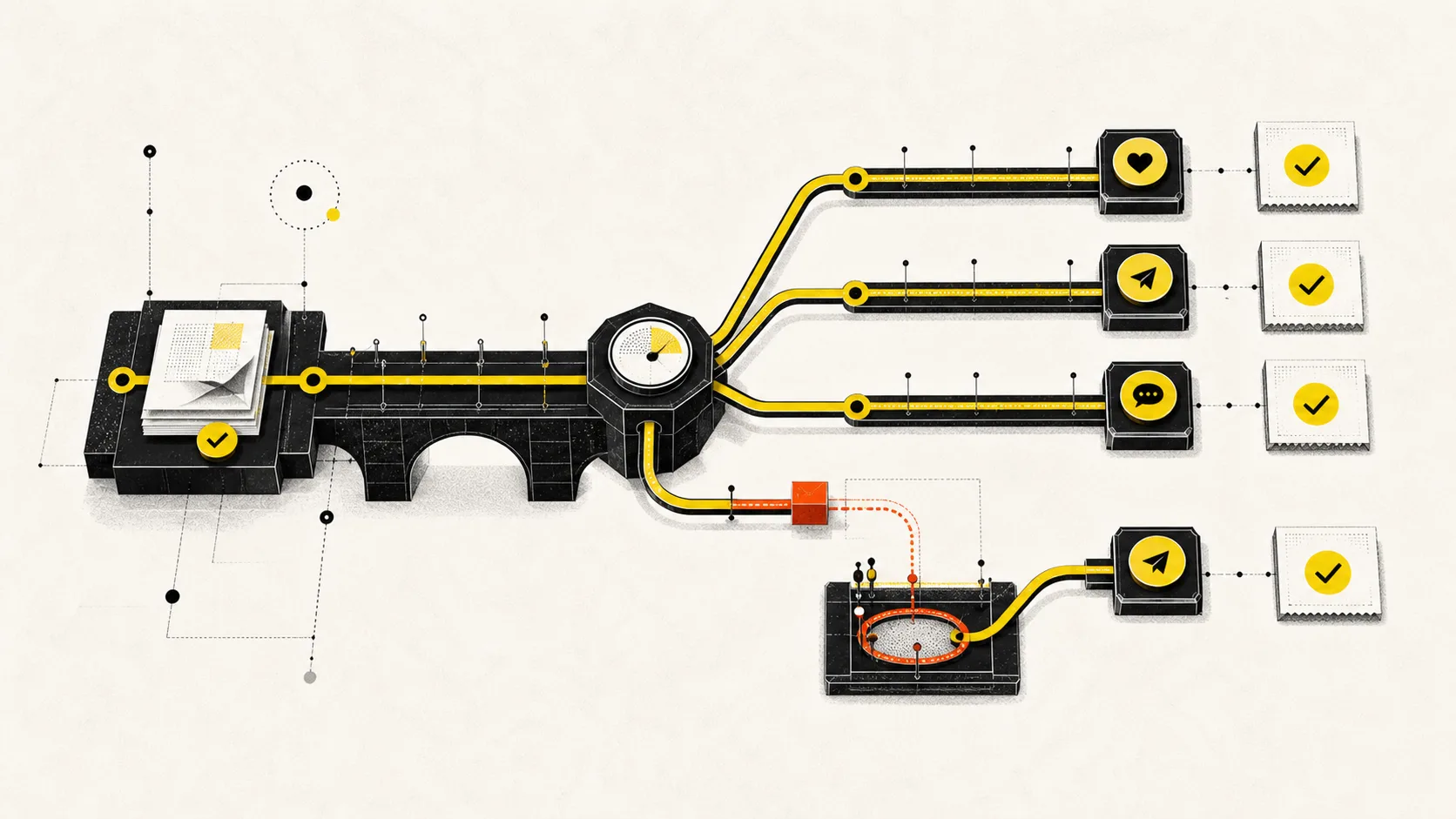
A social post can look ready in a calendar and still fail at the last step. An account connection expires. A video passes an internal review but violates a platform constraint. A provider accepts a request and responds too slowly, leaving the system unsure whether retrying will publish a duplicate. In a multi-channel campaign, three posts may go live while the fourth fails.
These are not merely inconveniences for the person on duty. They can break a launch sequence, send a team into conflicting manual fixes, and make the content record disagree with what the audience actually sees.
Reliable social publishing treats delivery as a production workflow with explicit states, verification, bounded recovery, and an owner. The objective is not to promise that failures never happen. It is to reduce preventable failures and make the remaining ones visible and recoverable.
The short version
- Define success as a verified live post on the intended account, not a successful click on “schedule.”
- Validate account access, required fields, assets, timing, links, and approvals before the delivery window.
- Use distinct lifecycle states such as scheduled, sending, accepted, live, retrying, failed, and unknown.
- Attach a unique attempt identifier and use idempotent behavior wherever the provider supports it.
- Retry only transient failures, with limits and awareness of whether the first attempt may have succeeded.
- Keep publish receipts and a human-readable incident queue.
- For partial multi-channel delivery, preserve successful posts and follow a campaign-specific recovery decision.
- Review incidents for system improvements, not individual blame.
Reliability is a property of the full path—from approved content to verified delivery—not any single tool.
Define the publishing contract
Before implementing checks or alerts, define what the team considers successful.
A useful publishing contract includes:
- exact brand and destination account;
- content version approved for delivery;
- media assets and their checksums or stable identities;
- intended publish window and time zone;
- channel-specific copy and metadata;
- link destination and tracking parameters;
- approval evidence and expiry rules;
- expected provider result;
- verification method;
- owner when the result is delayed or ambiguous.
“Scheduled” only means the system intends to attempt delivery later. “Accepted” may mean the platform received the request, not that the audience can see the post. “Live” should mean the platform has confirmed the content and the system has recorded a stable identifier or URL when available.
Write that distinction into the user interface and the team’s language. If every state displays the same green check, nobody knows when intervention is required.
Understand the main failure classes
Failures require different responses. Start with a practical taxonomy.
| Failure class | Example | Best prevention or response |
|---|---|---|
| Content validation | Caption or asset violates a channel constraint | Preflight validation before scheduling |
| Authentication | Token expired or permission was removed | Connection health check and owner alert |
| Authorization | User can read but not publish to the destination | Verify capability, not only connection |
| Media processing | Platform cannot process the video | Validate format; observe async processing |
| Rate or capacity limit | Provider temporarily rejects requests | Bounded backoff with delivery-window awareness |
| Provider outage | API is unavailable or degraded | Queue safely, communicate, and retry later |
| Ambiguous response | Request timed out after possible acceptance | Verify before retrying |
| Duplicate delivery | The same item is published twice | Idempotency and duplicate detection |
| Timing error | Wrong time zone or stale campaign date | Store explicit zones and run temporal checks |
| Partial campaign | Some destinations succeed and others fail | Preserve receipts and follow recovery policy |
Do not collapse all of these into “publish failed.” A validation error usually needs content changes. A temporary provider error may recover automatically. An ambiguous result must be investigated before any retry.
Validate early with a preflight gate
The worst time to discover a preventable problem is at the scheduled minute. Run preflight checks when the item enters the schedule and again shortly before delivery for conditions that can change.
Check five layers.
Content
- required copy is present;
- channel-specific length and formatting rules are satisfied;
- mentions, tags, and links are intentional;
- the approved version is still current;
- claims with expiration dates remain valid.
Media
- file type, dimensions, duration, size, aspect ratio, and count fit the destination;
- alt text or captions are present where required;
- media remains accessible to the publishing service;
- transformations did not replace the reviewed asset.
Account
- the connection is active;
- the authenticated identity maps to the expected brand account;
- required publish capability is present;
- a credential-expiry or reauthorization warning is surfaced early.
Timing
- the time zone is explicit;
- the scheduled time is in the future and within campaign bounds;
- embargoes, quiet periods, and known platform restrictions are respected;
- the item has not been superseded or paused.
Workflow
- all required reviewers approved the exact version;
- dependencies such as landing pages are ready;
- no unresolved block is attached;
- an owner and escalation path exist.
Preflight should explain failures in actionable language. “Invalid media” is less useful than “This destination accepts one video; the current variant contains one video and two images.”
Model delivery as explicit states
A dependable system does not jump from scheduled to published in a single opaque transition.
Use states such as:
- Scheduled: valid content is queued for a future attempt.
- Preflight blocked: a check failed before the delivery request.
- Sending: a delivery attempt has started.
- Accepted: the provider acknowledged the request or began processing.
- Live: delivery was verified and a provider identifier was recorded.
- Retrying: a retryable failure is waiting for another bounded attempt.
- Failed: delivery did not succeed and automatic recovery stopped.
- Unknown: the outcome cannot yet be determined safely.
- Cancelled: an authorized person or rule stopped delivery.
Every transition should record time, actor, attempt, and reason. This history answers critical questions during an incident: Was the content sent? Which version? Did the provider acknowledge it? Has somebody already retried manually?
Unknown deserves special respect. Treating ambiguity as failure and retrying immediately is a common way to create duplicates.
Make delivery idempotent
Idempotency means repeating an operation does not create an additional unintended effect. Social platforms vary in their support, so the publishing layer needs its own protections.
Assign a unique delivery identity based on the content item, approved version, destination, and scheduled occurrence. Track every attempt under that identity.
Before retrying:
- check whether the provider supports an idempotency key;
- inspect the recorded provider identifier;
- query recent destination content when permitted and reliable;
- compare content and media fingerprints;
- account for provider processing delays;
- prevent simultaneous workers or people from retrying the same delivery.
Do not infer that a timeout means nothing happened. The request may have reached the provider while the response was lost.
Manual publication also needs reconciliation. If a teammate publishes directly during an incident, they should attach the live URL or identifier to the original delivery record so automated recovery does not publish again.
Retry selectively and within the campaign window
Retries are appropriate for transient conditions such as temporary unavailability or rate limits. They are usually wrong for invalid content, missing permission, revoked credentials, or rejected policy-sensitive material.
A retry policy should define:
- which error classes are retryable;
- maximum attempts;
- delay and backoff behavior;
- randomization to avoid synchronized retries;
- the latest acceptable publish time;
- verification before another attempt;
- the state after retries are exhausted;
- who receives the escalation.
Campaign context changes the decision. An evergreen tip can tolerate a later delivery. A post that says “starting in ten minutes” cannot. When the acceptable window closes, stop automatic retries and ask whether to rewrite, reschedule, publish manually, or cancel.
Never let retries silently continue beyond the period when the content remains true.
Store a complete publish receipt
For every successful destination, keep a durable receipt containing:
- internal content and delivery identifiers;
- exact content version and media identities;
- destination platform and account;
- scheduled and actual publish times;
- provider post identifier and live URL when available;
- attempt history;
- provider response or normalized result;
- approval reference;
- actor or service responsible for the action.
The receipt supports analytics, audits, customer support, deletion or correction workflows, and incident reconstruction. It also lets the social media analytics system distinguish scheduled intentions from content that actually became live.
Keep sensitive credentials out of logs. Record what happened and which authorized connection was used, not the secret itself.
Detect failures before somebody notices the missing post
Detection should combine immediate workflow events with scheduled reconciliation.
Immediate signals include validation errors, authentication failures, provider rejection, exhausted retries, and a delivery stuck in sending or accepted beyond its expected time.
Reconciliation signals compare scheduled items with publish receipts and, where supported, the provider’s current state. They catch lost callbacks, deleted posts, delayed processing, and internal records that never reached a terminal state.
Alerts should be actionable and deduplicated. Include:
- affected brand and account;
- content and campaign;
- intended publish time and remaining window;
- current lifecycle state;
- error class and plain-language explanation;
- attempts already made;
- safe next actions;
- owner and escalation deadline.
Sending the same alert to everyone creates diffusion of responsibility. Route by account ownership, severity, and time zone, with a clear fallback.
Use a runbook for incident response
When an alert arrives, follow a stable sequence.
1. Stabilize
Pause automated retries if the outcome is ambiguous, the content may be unsafe, or multiple destinations are involved. Prevent concurrent manual actions.
2. Establish the actual state
Inspect attempt history, provider identifiers, and the live destination. Determine which accounts succeeded, failed, or remain unknown.
3. Protect the campaign
Check dependencies and timing. Decide whether remaining posts should pause while the issue is investigated.
4. Choose the recovery action
Options include waiting for processing, retrying safely, correcting content and requesting reapproval, publishing manually and reconciling the receipt, rescheduling, or cancelling.
5. Verify
Confirm the intended content is live exactly once on the right account. Record links and actual publish times.
6. Communicate
Update the owner and affected stakeholders using the agreed incident channel. State facts, current impact, and next checkpoint without guessing at a cause.
7. Learn
Preserve the timeline and create follow-up actions after delivery is stable.
A runbook should be short enough to use under pressure. Link to deeper provider-specific notes rather than embedding every possibility in one page.
Decide how to handle partial campaigns
Multi-channel delivery turns one publishing action into a distributed outcome. Define the recovery policy during campaign planning, not during the failure.
Common policies include:
Independent: Each destination stands alone. Successful posts remain live while the failed one recovers.
Coordinated window: Destinations may differ slightly, but all must publish within a defined period. Escalate when the remaining window becomes narrow.
All-or-pause: A high-stakes coordinated announcement pauses remaining destinations when any critical prerequisite fails. Already-live content may require a separate correction decision.
Do not automatically delete successful posts to restore symmetry. Deletion is another external action with its own audience and reputational effects. Give that decision to the named campaign owner.
The platform-native publishing guide helps define which variants belong to the campaign; the reliability policy defines how those variants behave as a group.
Review incidents without blame
A useful incident review asks how the system allowed the failure and why detection or recovery behaved as it did.
Record:
- intended outcome;
- user-visible and business impact;
- concise timeline;
- contributing technical and workflow conditions;
- signals that worked or failed;
- recovery actions and their consequences;
- changes to prevention, detection, response, or documentation;
- owners and due dates.
Avoid stopping at “the editor selected the wrong account.” Ask why multiple brands were indistinguishable, why the account was not verified at preflight, why the reviewer could not see the destination clearly, and why correction took as long as it did.
Track recurring classes. Several small credential failures may justify a connection-health dashboard. Repeated media rejection may justify earlier asset validation. The purpose of the review is to improve the system that produces the outcome.
Measure publishing reliability
Choose measures that reveal both audience impact and operational health:
- percentage of scheduled destinations verified live within their intended window;
- failures by class, platform, account, and workflow stage;
- time from first failure signal to acknowledgement;
- time from acknowledgement to verified resolution;
- percentage of incidents detected internally before stakeholder report;
- duplicate or wrong-account publications;
- manual interventions and their causes;
- items remaining in an unknown state;
- repeated incidents linked to the same unresolved condition.
Set targets from business needs and observed baselines rather than copying a generic standard. A time-sensitive news operation and a weekly evergreen program have different reliability requirements.
Pair the numbers with incident narratives. A low incident count can hide one severe wrong-account post; a higher count may reflect better detection of minor issues that were previously invisible.
A pre-launch reliability checklist
Before relying on a publishing workflow, confirm:
- success and every intermediate state are clearly defined;
- account identity and publish capability are verified;
- content and media constraints are checked before the delivery window;
- approval is bound to an exact version;
- time zones and latest acceptable publish times are explicit;
- every delivery has a unique identity;
- ambiguous outcomes are verified before retry;
- retries are bounded and error-specific;
- successful posts produce durable receipts;
- alerts name an owner and safe next action;
- partial campaign policy is documented;
- manual actions can be reconciled with the system;
- secrets are excluded from logs;
- provider-specific runbooks are current;
- incidents generate owned improvements.
Publishing reliability is easy to ignore when everything works. Building it into the workflow before the next launch is far cheaper than reconstructing a partial delivery from screenshots, messages, and guesswork.
Frequently asked questions
Why did a scheduled social post fail?
Common causes include expired authentication, missing publish permissions, invalid media or copy, platform limits, provider outages, incorrect timing, and failures during asynchronous media processing. The delivery record should preserve the provider response and the state in which it failed.
Should failed posts be retried automatically?
Only transient failures should be retried automatically, and the workflow must verify that the previous attempt did not succeed. Validation, permission, policy, and ambiguous-outcome failures usually require a different response.
How can a publishing tool prevent duplicate posts?
Use a unique delivery identity, provider idempotency support where available, attempt locking, durable provider receipts, and verification before retry. Reconcile direct manual publication with the original record.
What should happen when only some channels publish?
Follow the campaign’s predefined partial-delivery policy. Preserve successful receipts, pause unsafe retries, establish the real state of every destination, and let the campaign owner choose whether to recover, reschedule, rewrite, or cancel the remainder.
Is checking the live post necessary after the API succeeds?
Yes. An accepted request can still undergo processing or later fail. Record the provider identifier and verify the terminal live state when the platform supports it. The user-facing status should communicate the difference between accepted and verified live.