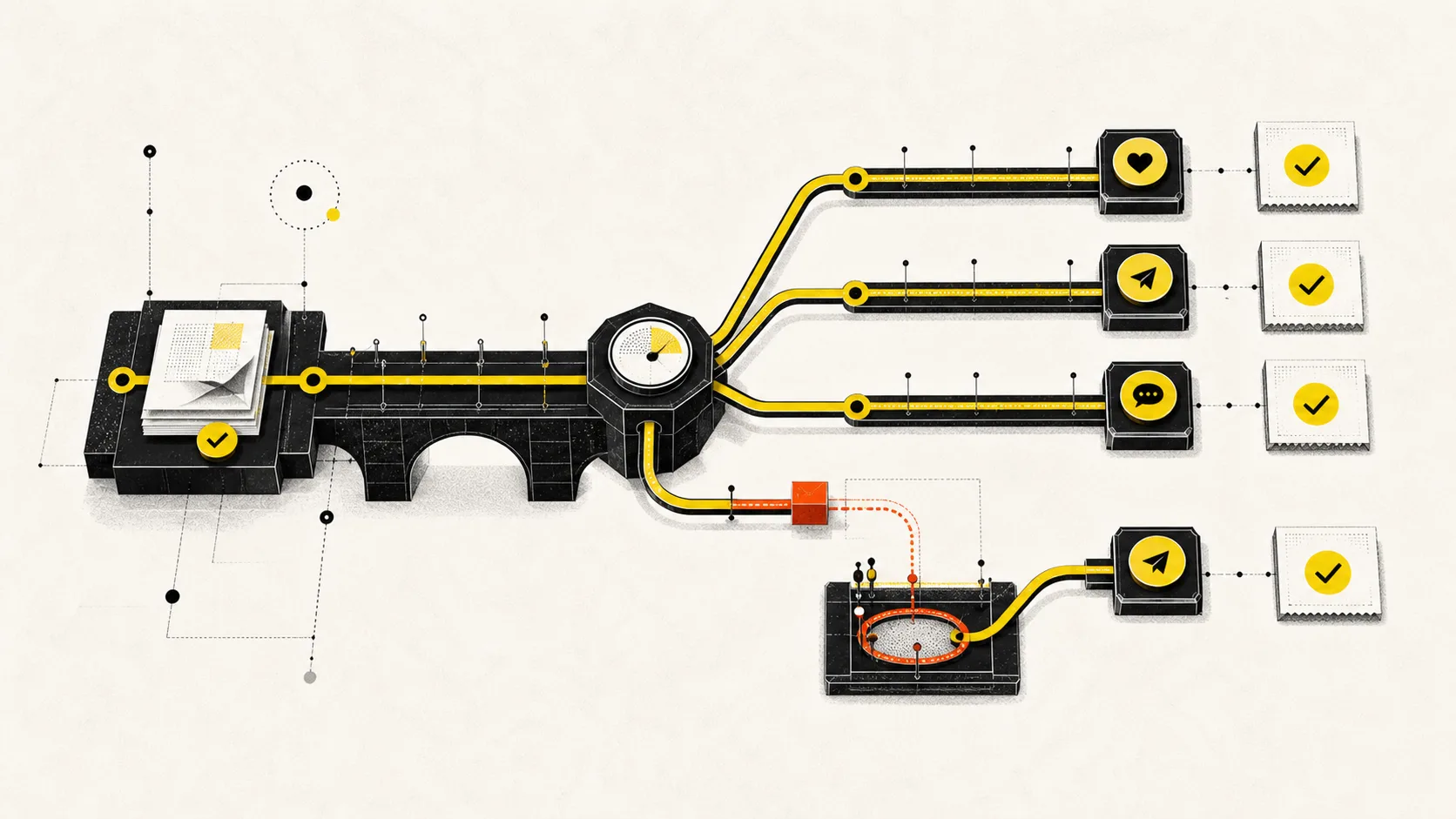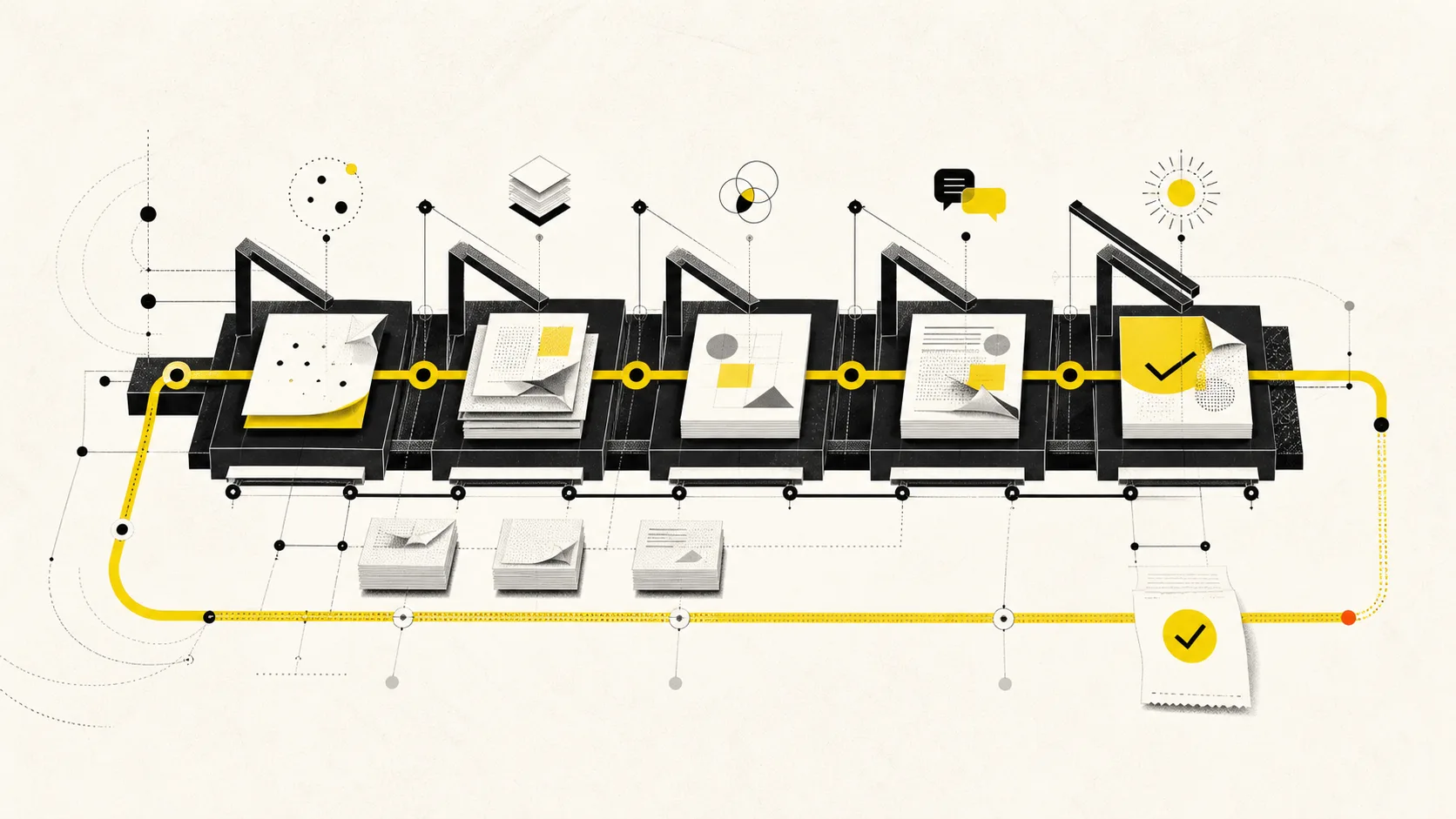
Multi-channel publishing creates a tempting false choice. Either the team copies the same post everywhere and saves time, or it creates every channel from scratch and loses the efficiency of a coordinated campaign.
There is a better model: one campaign truth, many native expressions.
The campaign truth holds the audience problem, promise, evidence, offer, constraints, and intended action. Channel variants translate that truth into the formats and conversation patterns people expect in each destination. The work stays coherent without becoming identical.
The short version
For every multi-channel campaign:
- Write a canonical message brief before any caption.
- Give each channel a specific role in the audience journey.
- Choose a native format and one main action per variant.
- Adapt structure, evidence, length, media, and interaction—not just character count.
- Validate platform requirements and rights before scheduling.
- Review variants together for consistency and individually for fit.
- Confirm provider publication instead of assuming the schedule succeeded.
The canonical message is the control plane. The variants are the public experience.
Begin with a canonical message brief
A useful brief should be precise enough to prevent contradiction and flexible enough to support creative adaptation.
Include:
- Audience problem: the situation the campaign addresses.
- Core promise: the value or change you can responsibly offer.
- Evidence: demonstration, customer observation, product behavior, research, or expert reasoning.
- Required facts: names, dates, availability, price, eligibility, and limitations.
- Prohibited drift: claims or implications the evidence does not support.
- Primary action: what the audience can do next.
- Campaign voice: how the brand should sound in this moment.
- Risk and rights: reviewers, disclosures, licenses, and consent.
- Measurement plan: what evidence would indicate progress.
Do not make a “master caption.” A caption already assumes a channel form. The brief should describe meaning.
Give each channel a role
Every destination should earn its place. Assign one main job based on audience behavior and campaign needs.
| Channel role | Useful content behavior | Typical success evidence |
|---|---|---|
| Discovery | Creates fast recognition of a relevant problem | Qualified reach, profile exploration, new audience replies |
| Education | Builds understanding with enough depth to be useful | Saves, completion, dwell, substantive questions |
| Proof | Makes the promise believable | Case engagement, demonstration depth, evaluation activity |
| Conversation | Invites informed response or participation | Relevant replies, community contribution, sentiment themes |
| Action | Helps an interested person take the next step | Click quality, signups, trials, requests, conversions |
| Retention | Helps existing users succeed or stay informed | Product adoption, support reduction, customer response |
One channel can perform several jobs over time, but one post should have a clear priority.
Without roles, teams choose channels by account availability and then wonder why identical posts produce uneven results.
Adapt six dimensions—not just length
1. Opening
The first moment must match how attention works in the destination. A search-led blog title can state the problem clearly. A short video may need to show the painful before-state immediately. A LinkedIn post can begin with an operating observation. A community post should enter the existing conversation without a campaign slogan.
2. Structure
Turn a process into a slide sequence, a demonstration into a video, a nuanced argument into long-form text, or a single insight into a concise discussion post. Do not compress an article until it becomes unreadable.
3. Evidence
Choose proof that survives the format. A product workflow can be shown in video, a comparison can become a table or carousel, and a customer decision can become a short narrative. Preserve the limits and attribution of the evidence.
4. Voice
Brand voice should remain recognizable while conversational distance changes. A professional network may support a reflective practitioner voice. A short video may be more direct and spoken. A support channel should favor clarity over campaign personality.
5. Interaction
Ask for an action the channel can support naturally: save a checklist, reply with an experience, watch a demonstration, read the full method, join an event, or start a trial. Avoid stacking several unrelated calls to action.
6. Packaging
Adapt media ratio, duration, captioning, thumbnails, alt text, link behavior, tags, mentions, first comments, and preview metadata. Packaging is part of communication, not a last-minute export setting.
Use channel cards instead of assumptions
Platform capabilities and audience norms change. Maintain a small channel card for every active destination.
Each card should record:
- strategic role and primary audience;
- formats the team can produce well;
- current account capabilities and provider limitations;
- copy, media, duration, and scheduling constraints;
- link, mention, tag, collaboration, and preview behavior;
- accessibility requirements and team standards;
- content that requires manual steps;
- reviewer or owner;
- monitoring expectations after publication;
- last verification date.
Treat numerical limits as operational configuration, not permanent marketing knowledge. Verify them against current provider documentation and the connected account before a high-stakes campaign.
BlendDuck’s integration catalog makes provider foundations and current channel coverage visible, but your team still owns channel strategy and account-specific requirements.
A worked campaign example
Imagine a B2B software company launching a feature that lets teams route social posts through approval before scheduling.
Canonical truth
Audience problem: feedback and approval are scattered, so teams publish late or use the wrong version.
Promise: keep review state connected to the exact post and schedule.
Evidence: show the draft, review decision, approved state, scheduled event, and publishing history in one workflow.
Action: explore the workflow or start a workspace.
LinkedIn: operating lesson
Open with a recognizable scene: “The slowest part of social approval is often finding out what has already been approved.” Explain why detached messages create version risk. Share the three-state model—reviewing, approved, scheduled—and include one product demonstration near the end.
Instagram: saveable visual framework
Use a carousel titled “Five things every approval request should include.” Give each slide one element: final copy and media, destination, decision owner, deadline, version. End with a compact checklist worth saving.
Short video: transformation
Show three scattered tabs in the first seconds, then the consolidated workflow. Use captions and a spoken explanation. Keep the product interaction legible; do not race through a full interface tour.
X, Threads, Bluesky, or Mastodon: debate
Lead with a precise claim: “Approval is not a message. It is a decision attached to a version.” Explain the implication in several concise points and ask practitioners where their process breaks.
Blog: complete implementation
Publish the full approval workflow guide with roles, risk routes, timelines, checklists, examples, and FAQs.
Newsletter: editorial context
Explain what the team learned while designing the workflow, link to the guide, and give subscribers one review question to adopt that week.
Each asset is recognizably part of the same campaign. None is merely a cropped copy of another.
Decide when cross-posting is enough
Cross-posting can be the right choice when:
- the audience and context substantially overlap;
- the format behaves similarly;
- the copy is complete without destination-specific features;
- mentions, links, tags, and media remain valid;
- speed matters more than format optimization;
- the post is low risk and easy to correct.
Adapt more deeply when:
- the channel role differs;
- the original relies on a format or interaction unavailable elsewhere;
- community norms reject promotional framing;
- the content includes important links, tags, or disclosures;
- video pacing, image ratio, or text density would weaken the experience;
- one account serves a different region, language, or customer group.
Even a cross-post deserves a destination check. “Same content” is not “same metadata.”
Keep variants connected without syncing every edit
Teams need a balance between shared context and independent execution.
Use a parent campaign or source item that stores the brief, proof, rights, objective, and shared assets. Create linked variants for each channel. Then classify changes:
- Global: corrected product name, launch date, required disclosure, or invalid claim. Update every affected variant.
- Local: channel hook, line breaks, tags, native call to action, or format-specific detail. Update only that variant.
- Review-triggering: a new claim, new asset, different offer, different region, or other material change. Route the affected variants back to approval.
Blind synchronization can overwrite good native work. Total separation allows campaigns to contradict themselves. Change classification keeps both risks visible.
Review the campaign in two passes
Pass 1: campaign consistency
Lay all variants side by side and ask:
- Do they share the same defensible promise?
- Are launch facts, names, dates, offers, and limitations consistent?
- Does each support the campaign objective?
- Are rights and required disclosures preserved?
- Does the sequence make sense if one person encounters several variants?
Pass 2: channel quality
Review each variant in a realistic preview:
- Does the opening work in that feed or context?
- Is the format legible and accessible?
- Are copy, media, links, tags, mentions, and thumbnail correct?
- Is the action appropriate?
- Does the post give enough value natively?
- Is the destination account correct?
Use the risk-based approval process for material campaigns.
Schedule the audience experience
A multi-channel calendar is not a race to publish every variant at once. Coordinate based on the journey.
- Let discovery content create recognition before asking for action.
- Publish the durable guide early enough to support later posts.
- Space similar hooks so followers on several channels do not see duplicates back to back.
- Keep room to answer emerging questions with new content.
- Coordinate fixed launches precisely, including time zones and embargoes.
- Assign people to monitor the channels where conversation matters.
Use one shared content calendar to see campaign density across channels and move flexible work without breaking fixed commitments.
Validate before publication
Run a preflight for every variant:
- correct brand, workspace, account, and destination;
- approved copy and media version;
- current provider requirements and account permissions;
- native crop, duration, audio, captions, thumbnail, and carousel order;
- readable text and meaningful alt text;
- working landing page and campaign tracking;
- valid tags, mentions, collaborator settings, and disclosures;
- date, time zone, embargo, and campaign spacing;
- monitoring owner and failure fallback.
Provider acceptance is a separate event. After scheduling, record whether the provider accepted the content. After the target time, record whether it actually published.
Measure channel contribution, not a universal leaderboard
Comparing raw reach across channels ignores their roles. Evaluate each variant against its intended job, then examine campaign-level movement.
For discovery, look for qualified new reach and profile exploration. For education, look for depth, saves, completion, and substantive questions. For proof, look for evaluation behavior. For conversation, analyze relevance and themes—not just reply volume. For action, follow the quality of visits and conversions.
Then ask:
- Which framing brought the right people into the campaign?
- Which explanation reduced confusion?
- Which proof changed evaluation behavior?
- Which channel revealed an objection worth addressing?
- Where did adaptation effort fail to add value?
The answer should change the next campaign brief.
Frequently asked questions
Should we publish on every social network?
No. Use channels that serve a clear audience and business role your team can support. An inactive or poorly adapted account can dilute attention. Start with fewer channels, learn their operating requirements, and expand when the system has capacity.
Is it harmful to post the same message on several platforms?
Not automatically. The same core message is useful for campaign coherence. Problems arise when identical packaging ignores audience context, format, metadata, and community norms. Preserve truth; adapt expression.
Which channel variant should be created first?
Create the version that contains the clearest complete expression of the idea, then use the canonical brief and content map for others. That may be a guide, demonstration, script, or live event—not necessarily the largest social network.
How much should copy change between channels?
Change as much as the channel role and audience experience require, while keeping approved facts and claims intact. Some text networks need light edits. A blog-to-video or research-to-carousel adaptation needs a structural rewrite.
Can AI create all channel variants automatically?
AI can produce useful first passes when it receives the canonical message, brand context, channel card, examples, constraints, and required claims. A person should still judge the hook, cultural fit, evidence, risk, and complete public experience before approval and scheduling.