Content repurposing is often presented as a shortcut: write a blog post, ask an AI tool for ten captions, and fill the calendar. That can create volume. It rarely creates a coherent body of useful work.
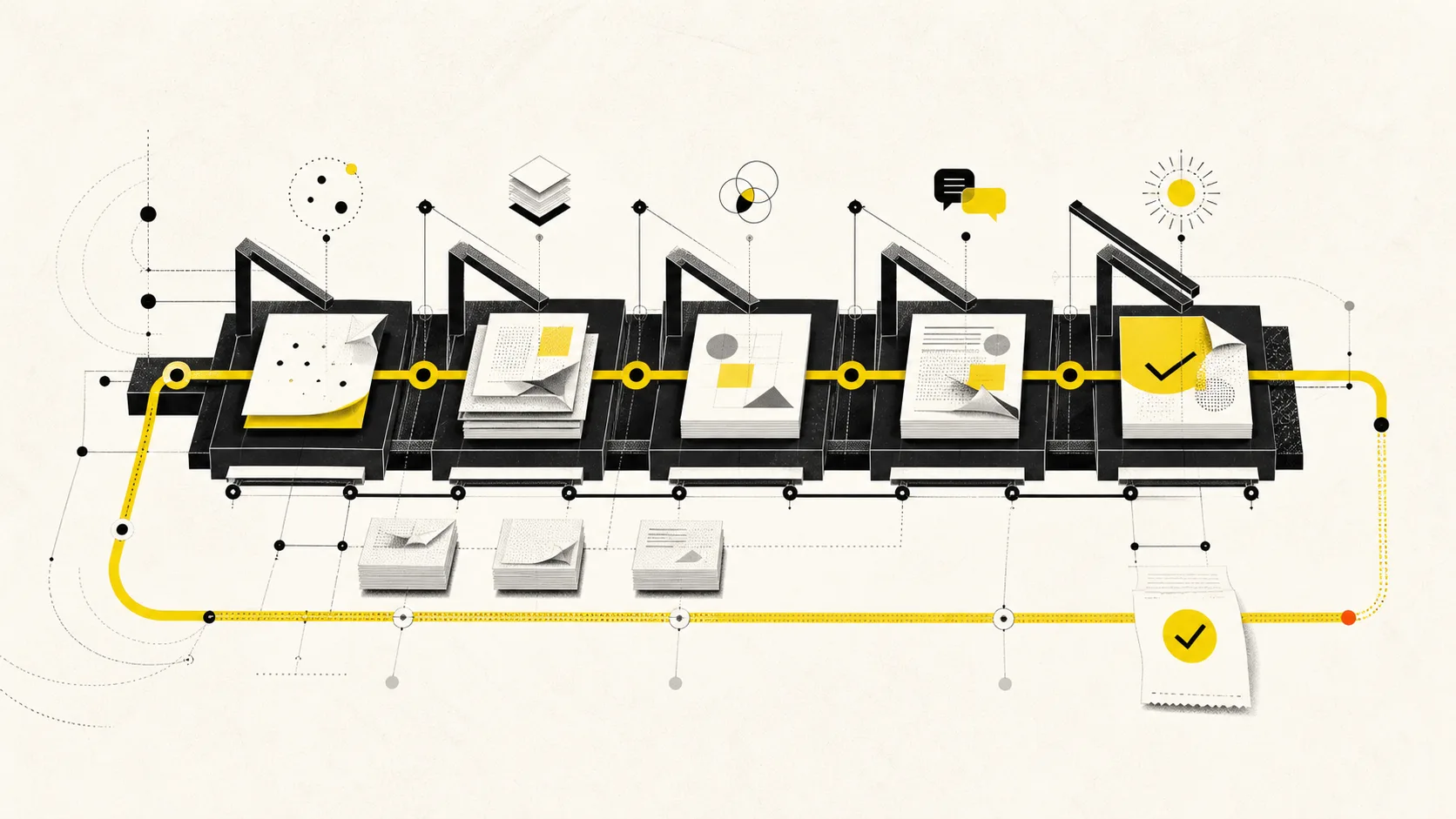
Good repurposing starts earlier. The source asset is designed to contain clear ideas, proof, stories, and examples. The team selects the parts that deserve another life. Each destination receives a version built for its own audience behavior. Results flow back into the next iteration.
The outcome is not ten smaller copies. It is a family of content that makes one valuable idea easier to discover, understand, trust, and act on.
The short version
Use this seven-step workflow:
- Choose a source with durable value and enough proof.
- Extract the idea, evidence, stories, objections, and actions into a content map.
- Match each fragment to a distinct audience moment.
- Choose formats based on how the platform is used.
- Write native variants from the map instead of trimming the original.
- Schedule a sequence that creates progression rather than repetition.
- Measure the family together and feed learning back into the source.
Repurpose meaning, not surface form.
Know the difference between reposting, cross-posting, and repurposing
These tactics solve different problems.
| Tactic | What changes | Best use | Main risk |
|---|---|---|---|
| Reposting | Little or nothing; same channel, later date | Resurfacing proven evergreen work | Audience fatigue or stale context |
| Cross-posting | Little or nothing; different channel | Fast distribution where formats and expectations overlap | Content feels imported and underperforms |
| Repurposing | Structure, format, framing, or depth | Reaching a new audience moment with the same core value | Losing the original idea during adaptation |
A short text insight may cross-post well across X, Threads, Bluesky, and Mastodon after small edits. A webinar becoming a LinkedIn document, a tutorial video, and a practical checklist is repurposing. Publishing the same carousel again three months later is reposting.
Use all three deliberately. Do not call every duplicate a content strategy.
Choose source material with more than temporary attention
High reach alone does not make a good source. Look for content with durable value density: several useful ideas, credible evidence, a clear point of view, and relevance beyond the original publication moment.
Strong candidates include:
- a complete guide that answers a recurring customer problem;
- a webinar with specific demonstrations and audience questions;
- a product launch with a meaningful operating story behind it;
- original research with several defensible findings;
- a customer workflow that reveals decisions, obstacles, and results;
- an expert interview with clear claims and memorable examples;
- a high-performing post whose comments expose deeper questions;
- a support pattern that many users struggle to understand.
Weak candidates include outdated announcements, unverified claims, posts that worked only because of a transient meme, and thin content with one idea already fully expressed.
Score a source from one to five on relevance, proof, modularity, shelf life, and connection to current objectives. Repurpose the work with the strongest combined score, not merely the newest file.
Build a content map before choosing formats
Read or watch the source and extract reusable units. A useful map includes:
Core promise
What does the audience gain? Write one sentence that every variant must preserve.
Key ideas
Identify three to seven claims or lessons that can stand alone without becoming misleading.
Proof
Collect examples, demonstrations, observations, screenshots, sources, and customer evidence. Record the limitations of each claim.
Stories
Find moments of tension, surprise, failure, change, or decision. Stories often travel better than summaries.
Objections and questions
Capture what a skeptical reader would ask and what the original audience actually asked.
Actions
List the practical steps, templates, checklists, or decisions someone can take.
Visual atoms
Mark diagrams, comparisons, before-and-after states, quotations, process stages, and demonstrations that can become visual content.
This map becomes the shared source of truth. It is more useful than repeatedly asking, “How can we turn this blog into a Reel?”
Match fragments to audience moments
One person may need the same idea at different stages.
- Discovery: “I did not know this problem had a name.” Use a sharp observation, diagnostic, or surprising contrast.
- Understanding: “Show me how this works.” Use an explainer, diagram, carousel, or example.
- Evaluation: “Will this work in my situation?” Use trade-offs, comparisons, customer workflows, or objections.
- Action: “What do I do next?” Use a checklist, template, demonstration, or step-by-step guide.
- Retention: “Help me get better results.” Use advanced practice, failure recovery, or operating routines.
If every variant summarizes the entire source, they all compete for the same moment. Assigning different audience jobs creates progression.
Design the content family
Imagine the source is a detailed guide to social media approval. A useful family might include:
| Asset | Audience job | Channel-native shape |
|---|---|---|
| Blog guide | Complete understanding and search discovery | Structured long-form with table, examples, FAQ |
| LinkedIn post | Diagnose a familiar team problem | Story-led text with one framework |
| LinkedIn document | Help a manager implement the process | Eight-page visual checklist |
| Instagram carousel | Make the risk model memorable | One level per slide plus saveable summary |
| Short video | Demonstrate the before-and-after | Fast scene: scattered feedback → one review object |
| X / Threads sequence | Invite practitioner debate | Strong claim, five operating rules, open question |
| Newsletter section | Connect the idea to current readers | Editorial context plus one practical action |
| Product education post | Show the workflow in use | Screen-led demonstration tied to a real task |
| Community response | Answer a specific objection | Full answer written for the conversation |
| Sales enablement note | Support evaluation | Risk checklist and workflow questions for buyers |
The family serves multiple needs without pretending every channel wants the same experience.
Write native variants from a blank page
Keep the content map open, then start each variant fresh. This prevents the source format from dictating every adaptation.
Lead with a recognizable work situation or informed point of view. Give the reader enough value in the post itself. Use whitespace and a clear progression. Do not make the audience click merely to understand the premise.
Instagram carousel
Design the argument spatially. The first slide earns attention, the middle slides create a sequence, and the final slide gives a useful recap or next step. Avoid shrinking paragraphs onto slides.
Short video
Show the problem or outcome early. Write for speech, not for a blog voice-over. Use visible actions, examples, and captions. One video should carry one main idea.
X, Threads, Bluesky, or Mastodon
Prefer a concise claim, concrete evidence, and a question or implication worth discussing. Threads should earn each additional post. Remove generic scene-setting.
Reddit and specialist communities
Contribute the complete useful answer in context. Respect community rules, disclose relevant affiliation, avoid forced links, and adapt the tone to an actual discussion rather than a campaign.
Newsletter
Add editorial context. Explain why this matters now to subscribers and what they should do with the idea. A newsletter is a relationship, not a list of external links.
The platform-native publishing guide goes deeper into adaptation decisions.
Preserve truth while changing the frame
Repurposing creates claim drift. A nuanced finding becomes a universal statement. A customer result becomes a guaranteed outcome. A screenshot loses the date or conditions that made it meaningful.
Create a small claim ledger in the content map:
- exact approved wording;
- supporting evidence or source;
- relevant date and scope;
- prohibited exaggerations;
- required disclosure or attribution;
- reviewer for any changed interpretation.
Every variant can simplify structure without changing what the evidence supports.
Also verify rights. Permission to publish a customer story on a website may not automatically cover paid social, a video edit, or an employee’s personal account. Treat music, people, third-party graphics, and user-generated content as rights decisions, not free raw material.
Schedule a sequence, not a content dump
Publishing every adaptation in the same 24 hours makes the audience feel surrounded by one campaign. Build a sequence with space for response and learning.
Example four-week arc:
Week 1 — discovery. Publish the strongest problem-led observation and the complete anchor guide.
Week 2 — understanding. Share a visual framework and a short demonstration. Answer early audience questions.
Week 3 — evaluation. Publish a case, trade-off, or objection-led post. Adapt a useful comment into a deeper response.
Week 4 — action. Offer the checklist, template, or implementation walkthrough. Resurface the anchor for people who joined the conversation late.
Use the content calendar method to balance the family with other pillars and campaigns.
Add repurposing to the original brief
The easiest time to plan distribution is before the source is finished. Add these prompts to every anchor brief:
- What is the one idea every adaptation must preserve?
- Which sections can stand alone?
- What original proof or demonstration will we capture?
- Which audience questions should the source answer explicitly?
- What visual atoms can design or video collect during production?
- Which channels and audience moments matter?
- What rights and approvals cover the planned formats?
- Who owns the family after the source publishes?
An interview recorded with clean audio, considered framing, and explicit reuse permission creates more options than a transcript rescued afterward. A guide written with clear sections creates better derivative scripts and carousels than an uninterrupted essay.
Use AI as a transformation assistant, not a content factory
AI can speed up mechanical work:
- extract candidate ideas, examples, and questions from a long source;
- group audience comments into themes;
- propose different hooks for an approved idea;
- convert a structured section into a first-pass script or carousel outline;
- adapt length and tone within documented brand guidance;
- identify repeated phrasing across a content family;
- check whether a variant omitted required context.
Humans should still choose the idea, validate the evidence, decide the audience job, judge cultural and channel fit, and approve public claims. Generated variants that all share the same polished rhythm are easy to recognize and easy to ignore.
BlendDuck’s AI agent workflow can work from the same brand and channel context while keeping drafts and publishing state visible to the team.
Measure the family, not only individual posts
An adaptation may play an important role without winning the reach leaderboard. Measure at three levels.
Asset performance
Did the format earn the attention and action expected on that channel? Use reach, depth, saves, shares, replies, clicks, watch behavior, or conversions as appropriate.
Audience progression
Did discovery assets lead people toward deeper education, evaluation, or action? Look for repeated audience names, assisted visits, profile exploration, newsletter growth, and qualified conversations.
Production efficiency
Did the family increase useful output without lowering quality? Track time per adaptation, approval rounds, rework, rights issues, and how much of the planned family actually shipped.
Do not divide total impressions by production hours and declare victory. Efficiently producing forgettable content is not the goal.
A practical repurposing checklist
Before selecting a source:
- it remains relevant;
- the core claim is defensible;
- it contains multiple useful units;
- rights permit the intended reuse;
- the idea supports a current objective.
Before creating variants:
- the content map is complete;
- each asset has one audience job;
- format and channel are chosen intentionally;
- claims and required context are documented;
- owners, dates, and reviewers are assigned.
Before publishing:
- the variant feels native, not resized;
- it gives value without depending on the source;
- media, captions, links, tags, and disclosures are correct;
- the sequence leaves room for response;
- performance will be connected back to the family.
Frequently asked questions
How many pieces should one source become?
As many as the source can support without repetition or claim dilution. A rich guide may produce ten useful assets; a focused insight may produce two. Start with distinct audience jobs rather than a quota.
How old can content be and still be repurposed?
Age matters less than validity. Verify claims, examples, links, product behavior, screenshots, platform rules, and cultural context. Refresh the source when necessary and label historical observations honestly.
Is cross-posting bad?
No. It is efficient when channel formats and audience expectations overlap. Review the copy, mentions, media, links, and tone before publishing. Cross-post because the content fits, not because the button exists.
Should the anchor content always be a blog post?
No. A webinar, customer conversation, product demonstration, research report, podcast, event, or strong social discussion can be the source. Choose the richest trustworthy material for the audience and objective.
How do we avoid sounding repetitive?
Change the audience moment, question, proof, story, format, and depth while preserving the core idea. Space the sequence, respond to what people say, and stop when the family has delivered its useful variations.