
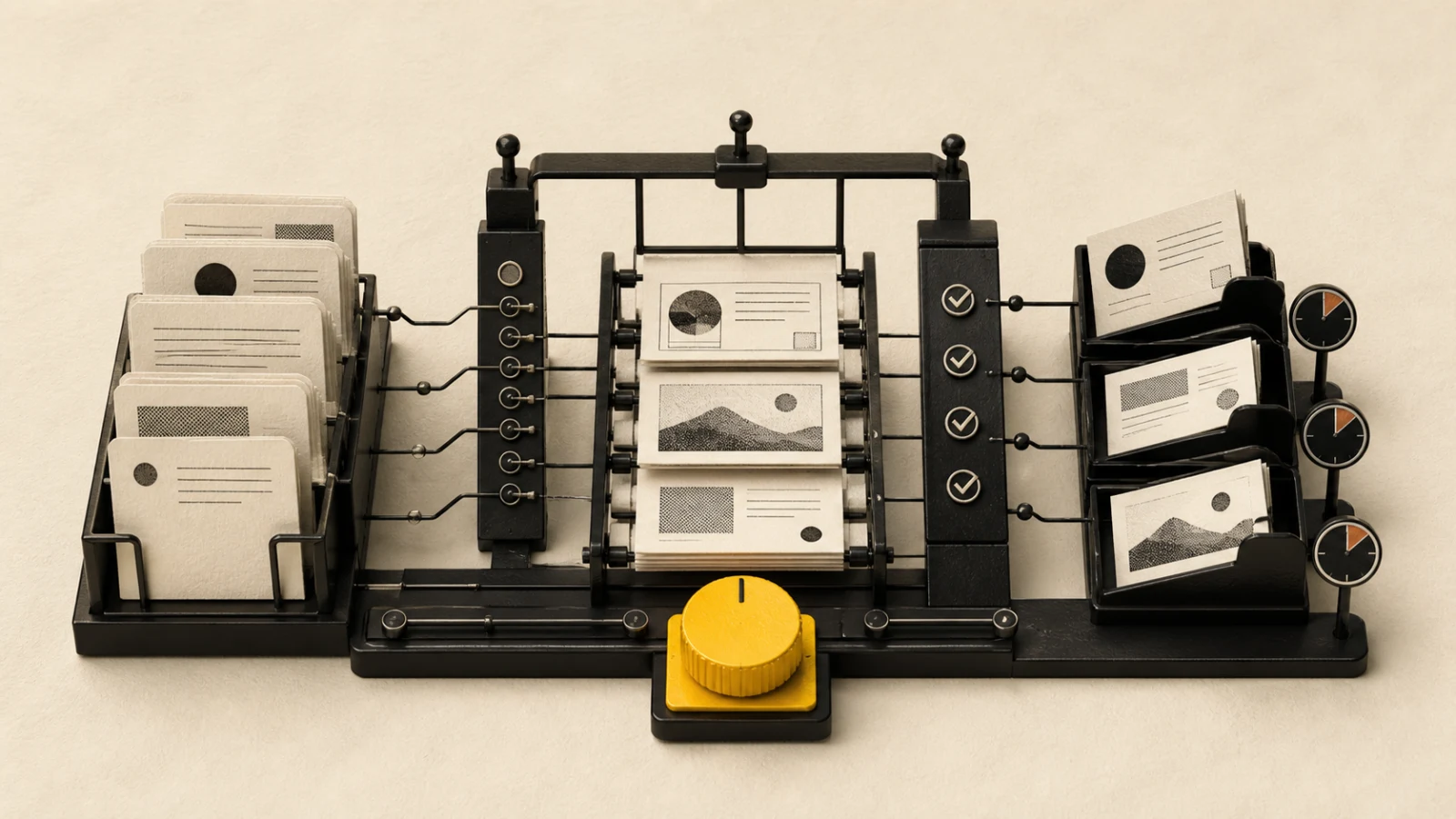
There is no single posting time that is best for every LinkedIn audience. Geography, work pattern, topic, account history, format, and distribution conditions all matter. A useful guide should give the team a starting baseline and a method for replacing it with its own evidence.
Current BlendDuck publishing contract
LinkedIn posts require commentary, including media posts, and support up to 3,000 Unicode characters. BlendDuck currently publishes text, one MP4 video, or up to twenty JPEG, PNG, or GIF images. Images and video cannot be mixed.
Each image must contain fewer than 36,152,320 pixels. Video must be MP4 and between three seconds and thirty minutes. The current BlendDuck contract supports multi-image posts, which can be designed as a swipeable visual sequence. It does not claim PDF or document-carousel publishing through this workflow.
Build an image carousel as one argument
Start with one audience problem and one promised outcome. Give each image a role:
- Establish the question, result, or tension.
- Define the context and why it matters.
- Develop the method, evidence, or examples.
- Resolve the argument and offer a proportionate next step.
Use a consistent canvas, type scale, margin, and page marker. Keep text readable at phone size and avoid turning every image into a paragraph. The sequence should remain understandable if a reader pauses halfway through.
The commentary is not a duplicate cover slide. It can frame who the sequence is for, add a source or limitation, and explain the practical consequence. Put important context before a long block of hashtags.
Establish a timing baseline
First-party and industry studies can suggest hypotheses, but they cannot know your audience's workday. Begin with two or three plausible weekday windows in the audience's dominant timezone, based on when the intended readers can reasonably notice and engage with the topic.
Create a test matrix that holds topic family, objective, format, account, and quality threshold as stable as possible. Rotate comparable posts across the windows for several weeks. Record the actual publish time, timezone, initial distribution conditions, and any launch or news event that could distort the result.
Do not choose a winner from one viral post. Use a defined sample and report median or distribution, not only the average. Separate early operational signals from the final measurement window.
Choose metrics that match intent
For an educational carousel, saves, qualified comments, profile visits, or downstream resource actions may matter more than raw impressions. For an announcement, reach among the intended audience and qualified clicks may be more useful. Define the metric before publishing.
Segment results by format. A text observation, multi-image sequence, and video can have different consumption patterns. Also record creative strength, topic relevance, and employee or partner amplification so timing does not receive credit for every other variable.
Revisit the baseline quarterly or when audience geography, company rhythm, content mix, or platform behavior changes. The goal is a dependable operating window, not a permanent universal rule.
Approval and publishing verification
Check required commentary, media count, image format and pixel count, order, names, claims, links, accessibility, rights, timezone, and approved version. A reordered image set is a changed editorial sequence and may require review.
After sending, preserve accepted, processing, live, failed, and unknown states. Inspect the public order and commentary, save the URL, and investigate before retrying. Record the planned window and actual live time separately when provider processing causes delay.
LinkedIn carousel and timing checklist
- Commentary is present and within 3,000 characters
- Post uses up to twenty JPEG, PNG, or GIF images
- Every image is below the pixel-count limit
- Sequence uses a consistent canvas and readable type
- Timing hypothesis, timezone, metric, and test window documented
- Topic, objective, format, and quality are controlled where possible
- Approved order matches the scheduled order
- Actual live time, URL, and result recorded
Current product limits were verified on 2026-08-23 against BlendDuck's LinkedIn platform contract. Timing guidance is a testing method, not a universal best-time claim.


