
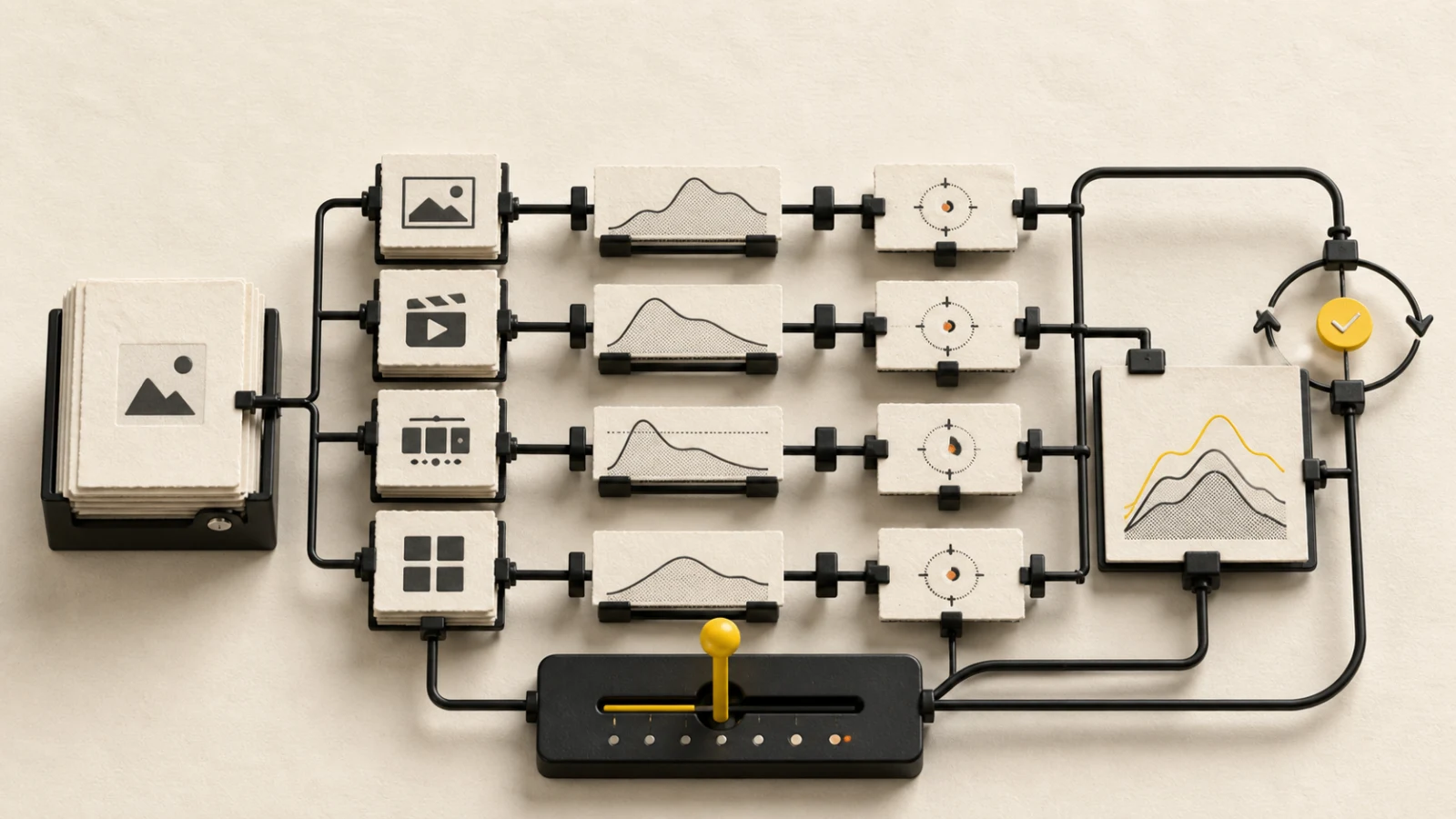
Instagram does not use one permanent ranking formula for every surface. Feed, Reels, recommendations, Explore, Stories, search, and profile discovery can serve different user jobs. Public platform explanations can describe broad signal families, but they do not reveal a stable set of weights that a team can reliably reverse-engineer.
Define the surface and audience question
Start with the specific distribution surface and desired audience behavior. A Feed carousel intended to earn saves from existing followers is not directly comparable with a Reel intended to reach new accounts or a Story intended to support an active launch.
For each test, record account, market, language, audience, format, content pillar, original or reused status, organic or paid boundary, publication time, accessibility treatment, rights status, and observation window. Preserve the exact caption, media version, audio, collaborators, tags, links, and account settings that may affect interpretation.
Choose a primary question such as:
- Which opening makes the value clear before a viewer scrolls?
- Does a carousel explanation produce more qualified saves than a single image?
- Which Reel structure retains the intended audience through the proof?
- Does a collaborator post change relevant discovery or only raw reach?
Measure observable distribution and response
Use metrics that exist for the tested surface and account. Reach, impressions, plays, watch time, completion signals, saves, shares, comments, profile actions, follows, link actions, and negative feedback can each answer a different question. Record platform definitions and data availability instead of treating similarly named values as identical.
Separate followers and non-followers where the platform exposes that view. Separate discovery from useful response: a high non-follower reach number may be valuable for awareness, but it should not automatically outweigh weak retention, irrelevant comments, or no downstream action.
Track absolute results and labeled rates. A high save rate on very small reach and a lower save rate on meaningful reach may lead to different decisions. Pair engagement with accessibility, moderation load, production effort, and content risk.
Test creative variables one at a time
Create comparable cells for opening, format, length, proof placement, visual structure, caption depth, call to action, collaboration, and timing. Avoid changing all variables between posts and then attributing the result to one fashionable tactic.
For Reels, test whether the first frames identify the audience and promise, when proof appears, whether the visual remains understandable without sound, and where attention declines. For carousels, test cover clarity, information order, slide density, save value, and whether the final action fits the content.
Use original assets or verify rights before adapting customer, creator, audio, or trend material. A trend is not an experiment unless the audience, hypothesis, comparison, and decision rule are defined.
Build a repeatable account baseline
Group results by surface, format, content pillar, audience job, and observation window. Review median, range, sample size, and outliers. Do not combine a launch giveaway, evergreen tutorial, creator collaboration, and routine product update into one account-wide “algorithm score.”
Maintain a rolling baseline rather than a universal benchmark. Retest after major audience changes, format shifts, product updates, account restrictions, seasonality, or sustained performance decay. Date-stamp any platform guidance used in the test.
Instagram reach test checklist
- Surface, audience, format, pillar, objective, and window fixed
- Exact approved media, caption, audio, tags, collaborators, and settings preserved
- Metric definitions and follower/non-follower boundaries documented
- Discovery, retention, meaningful response, and downstream action separated
- One primary creative variable changes per comparison
- Rights, disclosure, accessibility, moderation, and negative feedback reviewed
- Median, range, sample size, effort, and outliers included
- Account rule has a scope, confidence level, and retest date
Use the engagement-rate calculator for labeled denominators and the best-time testing guide for schedule experiments.


