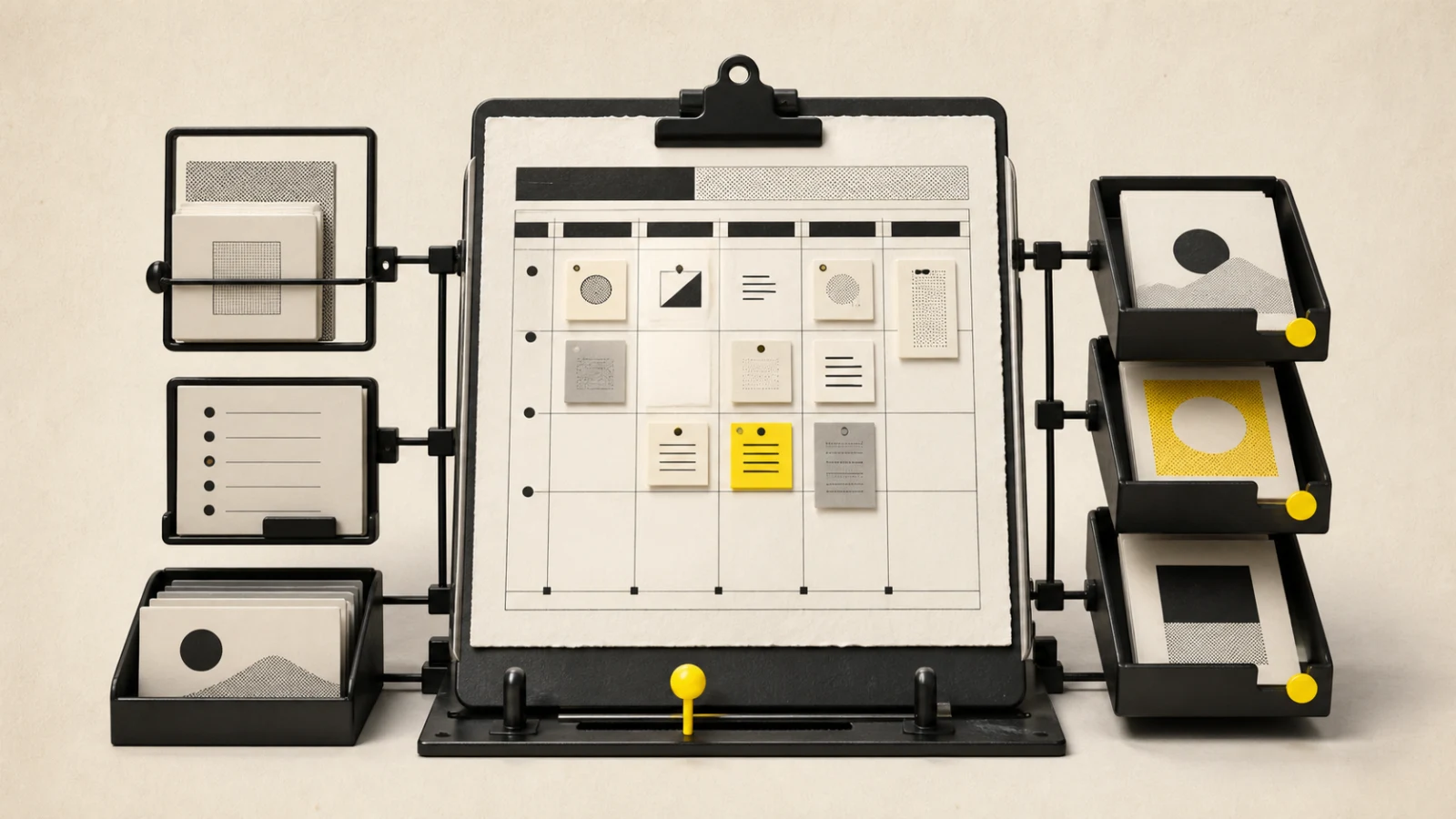
A social media strategy is a set of choices, not a list of platforms. It should explain which business change social can influence, whose behavior matters, why each channel deserves investment, what the team will repeatedly create, and how evidence will change the plan.
Download the strategy template
Use one row per strategic decision area. The template can live in a spreadsheet, database, or planning workspace, but every material choice should retain an owner, evidence, decision date, review date, and current status.
Do not fill the document with universal goals such as “grow awareness” or “increase engagement.” Translate the business context into an observable audience or operating change. Examples include increasing qualified product discovery among a defined segment, reducing support confusion about a new workflow, or creating a reliable source of customer questions for product learning.
Define the strategic boundary
Start with the planning period, markets, brands, products, accounts, budget boundary, available capacity, and non-negotiable constraints. State what the strategy does not cover. A plan for one launch should not quietly become the permanent strategy for every account.
Name the primary audience and the situation in which the brand is relevant. Record the audience problem, current behavior, desired behavior, evidence, and important exclusions. Separate known facts from assumptions that require testing.
Choose a small number of objectives. For each objective, define the business connection, the audience change, the social contribution, the primary metric, the measurement window, and the decision that will follow from the result. Social rarely controls the whole outcome, so avoid claiming direct causality when the evidence only supports contribution.
Give every channel a job
Evaluate channels by audience fit, native behavior, content capability, community expectation, measurement availability, operating cost, and risk. A channel should have a clear role such as discovery, education, proof, conversation, customer support, event coverage, creator collaboration, or conversion assistance.
Do not require every idea to appear everywhere. Define which content pillars belong on each channel, which formats are sustainable, what must be adapted, and what the team will deliberately stop producing. Link the strategy to the content pillar guide and content calendar template.
Set a publishing range rather than an aspirational fixed volume. Capacity must include research, creation, adaptation, accessibility, rights, approval, publishing, moderation, measurement, and recovery—not only writing time.
Turn the plan into governance and learning
Assign an owner for strategy, each channel, editorial quality, community response, measurement, rights, approval, and incidents. Define risk tiers and which claims, offers, customer materials, partnerships, or sensitive topics require additional review.
Create a measurement dictionary before reporting. Each KPI needs a name, formula, numerator, denominator, data source, timezone, attribution boundary, and freshness expectation. Use the KPI guide to keep comparisons valid.
Plan a small experiment portfolio. Every experiment should state a question, controlled change, comparison, success criterion, minimum observation window, owner, and next decision. Preserve unsuccessful tests; they prevent the team from repeating the same unsupported idea.
Review monthly for execution changes and quarterly for strategic changes. A platform trend may change a format test, but it should not automatically replace the audience problem or business objective.
Strategy review checklist
- Planning period, scope, constraints, capacity, and exclusions are explicit
- Priority audiences, situations, behaviors, and evidence are documented
- Objectives describe a measurable audience or business contribution
- Every active channel has a distinct role and exit condition
- Content pillars and channel-native formats are sustainable
- Ownership, approval, rights, accessibility, and incident paths are defined
- KPIs have formulas, sources, windows, and decision rules
- Experiments, review cadence, and stop-doing decisions are recorded
Treat the template as a living decision record. When a choice changes, preserve the old decision, evidence, date, and reason instead of silently rewriting history.